Why Depression Treatment Navigator?
Phenotype-Driven Selection
Matches initial pharmacotherapy to clinical specifiers (e.g., anxious distress, insomnia, psychomotor slowing, chronic pain) while filtering against organ contraindications, hepatic/renal clearance, and pregnancy/lactation safety.
Closed-Loop Measurement Care
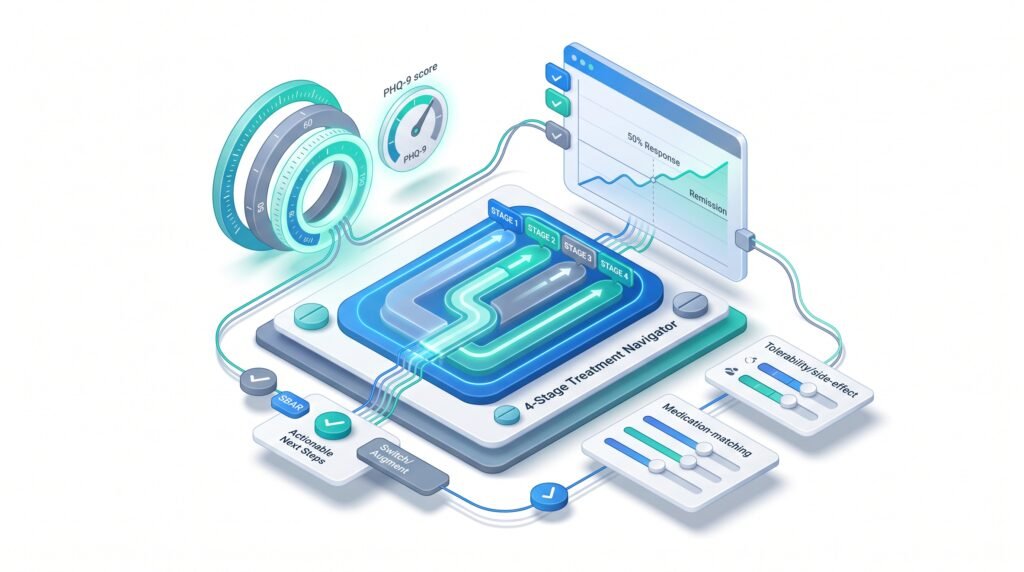
Integrates baseline PHQ-9 scoring with longitudinal follow-up nodes, automating response rate calculations (≥50% response vs. remission vs. pseudo-resistance).
Actionable Next Steps
Eliminates clinical guesswork by generating exact cross-titration schedules, washout intervals, evidence-backed augmentation regimens, and structured SBAR referral summaries.
Clinical Workflow: 4-Stage Architecture
Stage 1: Phenotyping & Intake Screener
- Interactive PHQ-9 Matrix: Rapidly score the 9 DSM-5 depression criteria. Scores ≥10 confirm criteria for pharmacotherapy; scores <10 prompt active surveillance or psychotherapeutic interventions.
- Item 9 Safety Guardrail: Endorsement of suicidal ideation (Item 9 ≥1) immediately flags crisis pathways and launches evidence-based safety evaluation protocols (C-SSRS / Stanley-Brown Safety Plan).
- Safety & Comorbidity Filters: Filter candidates across organ risks (prolonged QTc, hepatic impairment, seizure disorders, uncontrolled hypertension) and perinatal status (pregnancy and lactation compatibility).
Stage 2: Antidepressant Selection
- Algorithmic Match Scoring: View dynamic suitability scores across first- and second-line agents (SSRIs, SNRIs, NDRIs, NaSSAs, SMS/SARIs).
- Pharmacological & Tolerability Profiling: Review side-effect burdens at a glance with 5-point mini-meter chips evaluating sexual dysfunction, metabolic/weight gain risk, sedation, insomnia, GI distress, and discontinuation/withdrawal syndrome.
- Side-by-Side Comparison: Compare receptor binding profiles (Ki affinities for SERT, NET, DAT, 5-HT2A, H1, and M1) and dosing parameters.
Stage 3: Longitudinal Tracking & Optimization
- Trajectory vs. Clinical Thresholds: Plot longitudinal follow-up scores (Weeks 2, 4, 6, 8, 12) against projected benchmark curves and clinical cutoffs.
- Automated Status Stratification: Categorizes patients into Remission (PHQ-9 <5), Full Response (≥50% drop), Partial Response (25–49%), or Inadequate Response (<25%).
- Decision Branching: Direct cross-taper schedules, direct switches, or mandatory washout intervals alongside Level-1 and Level-2 augmentation protocols (Aripiprazole, Bupropion, Lithium, Esketamine).
Stage 4: Psychiatric Escalation & SBAR Referral
- 4-Tier Escalation Model: Identify criteria for specialized outpatient referral, intensive outpatient programs (IOP/PHP), or acute emergency crisis intervention.
- EHR-Ready SBAR Export: Instantly compile the patient’s intake metrics, failed trials, current dosing, and clinical rationale into a structured SBAR (Situation, Background, Assessment, Recommendation) note ready to paste into the chart.
How to Use the Navigator in Practice
- Set the Patient Profile: Choose a clinical archetype preset or enter custom patient parameters. Verify age is ≥18 and select relevant comorbidities (e.g., Anxious Distress, Renal Impairment, Breastfeeding).
- Complete the Baseline Intake: Fill out the 9-item PHQ-9 matrix to establish the Day 0 score and confirm safety criteria.
- Select Initial Agent: Advance to Stage 2 to inspect ranked agents. Review match percentages and side-effect profiles to align with patient priorities.
- Follow Up & Re-Assess: At follow-up visits (Weeks 2–6), log the latest PHQ-9 in Stage 3. If response is inadequate or the patient reports intolerance, follow the guided switch matrix or augmentation tiers.
- Refer When Indicated: If the patient meets treatment-resistant depression (TRD) criteria (≥2 failed adequate trials) or complex comorbidity, export the auto-generated SBAR note directly to your EHR.