Why Outpatient Leukocytosis Navigator?
Automated Lineage & Demargination Triage
Instantly classifies leukocytosis into distinct absolute cell lineages (neutrophilic, lymphocytic, eosinophilic, monocytic, or basophilic) rather than relying on relative percentages[cite: 1, 4]. Evaluates reactive demargination, glucocorticoid exposure, and smoking triggers alongside absolute cell counts[cite: 1, 2].
Active Safety Hard-Stops & Marrow Screening
Simultaneously screens for critical red flags including severe hyperleukocytosis (≥50 k/μL), peripheral blasts (>1%), marked left shift bandemia, and concurrent cytopenias (anemia or thrombocytopenia) to safeguard against missed hematologic emergencies[cite: 1, 4].
Synchronized Point-of-Care Documentation
Bridges diagnostic reasoning directly into practice with an instant #LEUKOCYTOSIS_EVAL# dotphrase export for your EHR and a printable, non-alarmist patient education handout written at a 6th-to-8th-grade reading level[cite: 1].
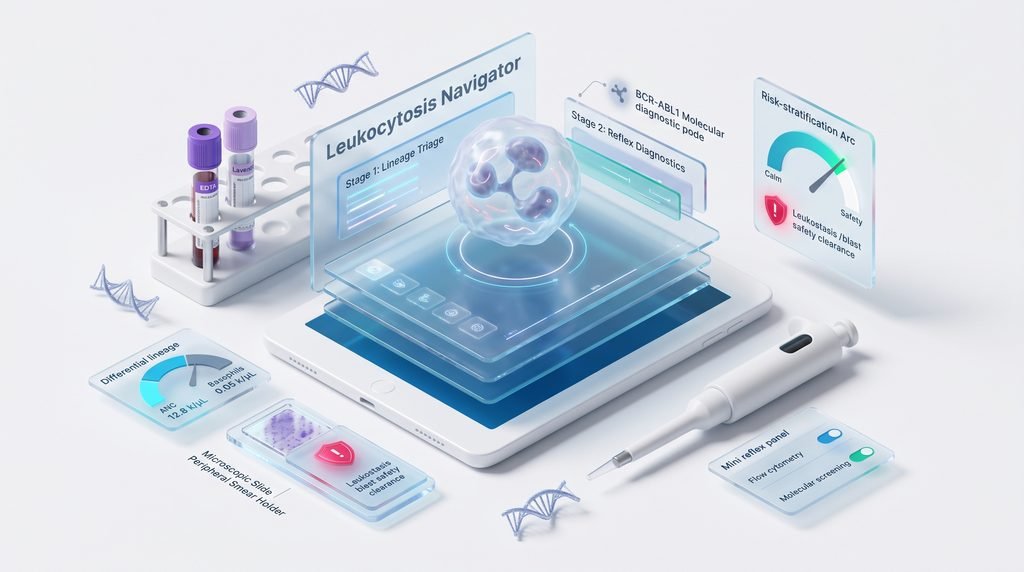
Clinical Workflow: 3-Stage Diagnostic Architecture
Stage 1: Quantitative CBC, Differential & Clinical Triage
- Quantitative Laboratory Entry: Ingests total WBC count, absolute counts (ANC, ALC, AEC, AMC, basophils), hemoglobin, platelets, and band percentage with immediate reference interval tracking[cite: 4].
- Clinical Context Matrix: Integrates rapid-toggle clinical exposure markers, including recent steroid bursts, active tobacco smoking, acute infection history, systemic B-symptoms, organomegaly, and new high-risk medications[cite: 2].
- Real-Time Decision HUD: Automatically stratifies the working differential hierarchy (reactive vs. clonal) while continuously checking for emergent safety hard-stops[cite: 1].
Stage 2: Reflex Diagnostics & Peripheral Smear Review
- Smear Morphology Checklist: Evaluates high-yield peripheral blood smear findings with color-coded risk flags, distinguishing blast cells and severe left shift from smudge cells, toxic granulations, and rouleaux[cite: 1].
- Targeted Reflex Workup: Recommends domain-specific workup tiers including molecular assays (BCR-ABL1 RT-PCR, JAK2 V617F), peripheral blood flow cytometry, and paraprotein / tryptase panels[cite: 1].
- One-Click Reflex Selector: Pre-populates only the high-yield diagnostic orders justified by the active dominant lineage and clinical presentation[cite: 1].
Stage 3: EHR Note Generation & Patient Education Handout
- Structured EHR Dotphrase (
#LEUKOCYTOSIS_EVAL#): Generates a complete 4-part chart note covering patient presentation, hard-stop safety status, ranked differential diagnosis, and outpatient follow-up orders[cite: 1]. - Print-Optimized Patient Guide: Delivers a clean, plain-language patient education handout explaining why white blood cell counts elevate, what monitoring steps are scheduled, and specific red flag symptoms requiring prompt re-evaluation[cite: 1].
How to Use the Leukocytosis Navigator in Practice
- Select a Preset or Input Patient Data: Choose an evidence-based clinical preset (such as reactive neutrophilia, CML, or hypereosinophilia) or manually enter your patient’s quantitative CBC values and clinical history toggles[cite: 1, 2].
- Review the Diagnostic Decision HUD: Confirm the primary cellular lineage classification, review the ranked differential impression, and verify that zero safety hard-stops or occult marrow cytopenias are triggered[cite: 1, 4].
- Reflex to Smear & Molecular Diagnostics: In Stage 2, review microscopic smear characteristics and identify warranted secondary reflex testing (e.g., flow cytometry, BCR-ABL1, or serum tryptase) based on dominant lineage criteria[cite: 1].
- Export Clinical Documentation: In Stage 3, use the 1-click clipboard copy to paste the formatted clinical reasoning note into your EHR progress note[cite: 1].
- Print the Patient Handout: Switch to the Patient Education Handout view to print a reassuring, structured explanation and warning symptom precautions directly for the patient[cite: 1].