Why Heart Failure Navigator?
Rapid 4-Pillar GDMT Optimization
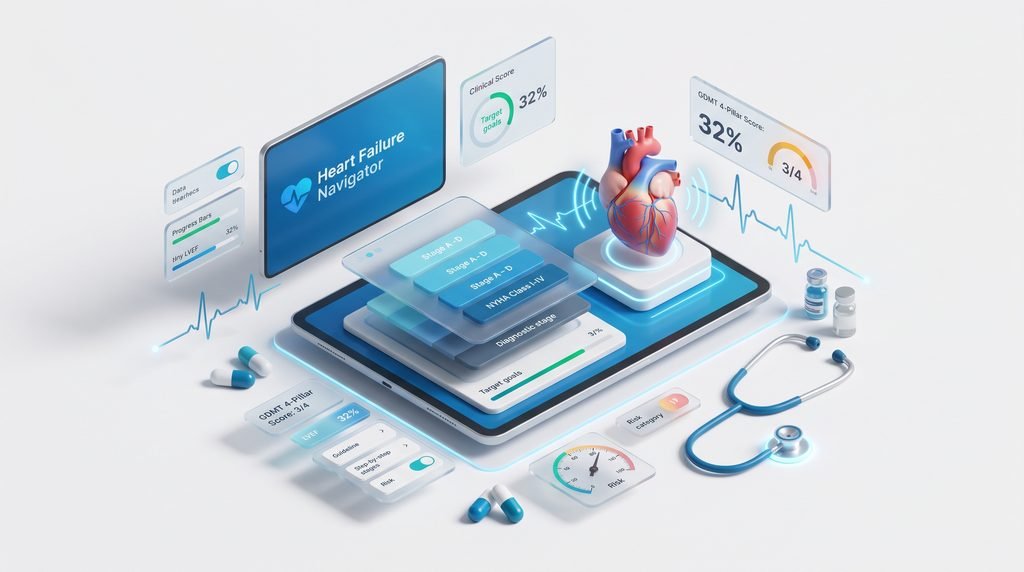
Streamlines the initiation and titration of evidence-based guideline-directed medical therapy (ARNI/ACEi/ARB, evidence-based Beta-Blocker, MRA, and SGLT2i) aligned with the 2022 ACC/AHA/HFSA guidelines, tracking percent-of-target doses in real time[cite: 1].
Objective Volume & Diuretic Triage
Calculates estimated target dry weight directly from physical congestion exam findings, provides loop diuretic equivalencies, and generates customized patient “BUMP” action protocols to prevent hospital readmissions[cite: 1].
Seamless EHR & Patient Handoff
Instantly generates a structured, copy-pasteable clinical progress note (.HFGDMT) for Epic, Cerner, or AthenaHealth, alongside a printable, single-page Green/Yellow/Red Zone Patient Action Plan[cite: 1].
Clinical Workflow: 4-Module Architecture
Module 1: Baseline Phenotype, Staging & Safety Labs
- Guideline Phenotyping: Dynamic LVEF slider and threshold classification for HFrEF (≤40%), HFmrEF (41–49%), HFpEF (≥50%), and HFimpEF (improved ejection fraction)[cite: 1].
- Staging & Functional Class: Structured selector cards for ACC/AHA Stages A–D and NYHA Functional Classes I–IV[cite: 1].
- Hemodynamic & Lab Hard Stops: Real-time cross-checks against resting blood pressure, heart rate, eGFR, serum potassium, creatinine, and natriuretic peptides (BNP/NT-proBNP)[cite: 1].
Module 2: GDMT 4-Pillar Titration Engine
- Quadruple Therapy Tracking: Itemized titration tiers (starting, intermediate, target) across all 4 guideline pillars with percent-of-target dose calculations[cite: 1].
- Automated Contraindication Screening: Intelligent safety checks for angioedema history, severe renal impairment (eGFR <30), hyperkalemia (K+ >5.0), 36-hour ACEi-to-ARNI washout, and bradycardia/AV block[cite: 1].
- Persistent Clinical HUD: A sticky bedside decision support card displaying real-time pillar adherence (0/4 to 4/4 active), safety alerts, and volume flags[cite: 1].
Module 3: Volume Status & Diuretic Triage
- Bedside Fluid Estimation: Evidence-based fluid deduction calculator translating peripheral edema, elevated JVD, rales, and ascites into estimated excess fluid volume and target dry weight[cite: 1].
- Loop Diuretic Conversion: Precise equivalency mapping between Oral Furosemide, Torsemide, and Bumetanide[cite: 1].
- Self-Care BUMP Protocols: Actionable outpatient dose-doubling instructions triggered by acute weight gains (>3 lbs in 24 hours or >5 lbs in 1 week)[cite: 1].
Module 4: EHR Dotphrase & Patient Action Plan
- Outpatient EHR Progress Note: One-click generation of a cleanly formatted
.HFGDMTclinical summary detailing phenotype, 4-pillar reconciliation, net fluid overload, and monitoring timelines[cite: 1]. - Single-Page Action Plan: Formatted patient takeaway handout featuring color-coded Green (All Clear), Yellow (Caution/Diuretic BUMP), and Red (Emergency) action zones[cite: 1].
- Zero Data Transmission: Operates entirely in client-side memory without transmitting or caching Protected Health Information (PHI)[cite: 1].
How to Use Heart Failure Navigator in Practice
- Classify Phenotype & Enter Baseline Labs: Drag the LVEF slider or type the measured ejection fraction to classify the patient’s HF phenotype[cite: 1]. Select the ACC/AHA stage, NYHA functional class, and enter baseline vitals and renal labs (SBP, HR, eGFR, K+)[cite: 1].
- Reconcile 4-Pillar GDMT Regimens: Review each of the 4 guideline pillars[cite: 1]. Select current agent dosages to verify guideline target percentages, or review automated clinical alerts and hard stops for held therapies[cite: 1].
- Assess Congestion & Dry Weight: Document bedside congestion signs (edema grade, JVD, crackles) and click “Estimate from Exam Findings” to compute target dry weight, fluid overload delta, and baseline loop diuretic regimens[cite: 1].
- Export Clinical Documentation: Review the persistent HUD, navigate to Module 4, and click “Copy EHR Note (.HFGDMT)” to paste the comprehensive progress note directly into your EHR[cite: 1].
- Provide Patient Handout: Click “Print Patient Action Plan” to generate an 8.5″ × 11″ Green/Yellow/Red zone self-management guide with personalized target dry weight and diuretic contingency instructions for the patient[cite: 1].